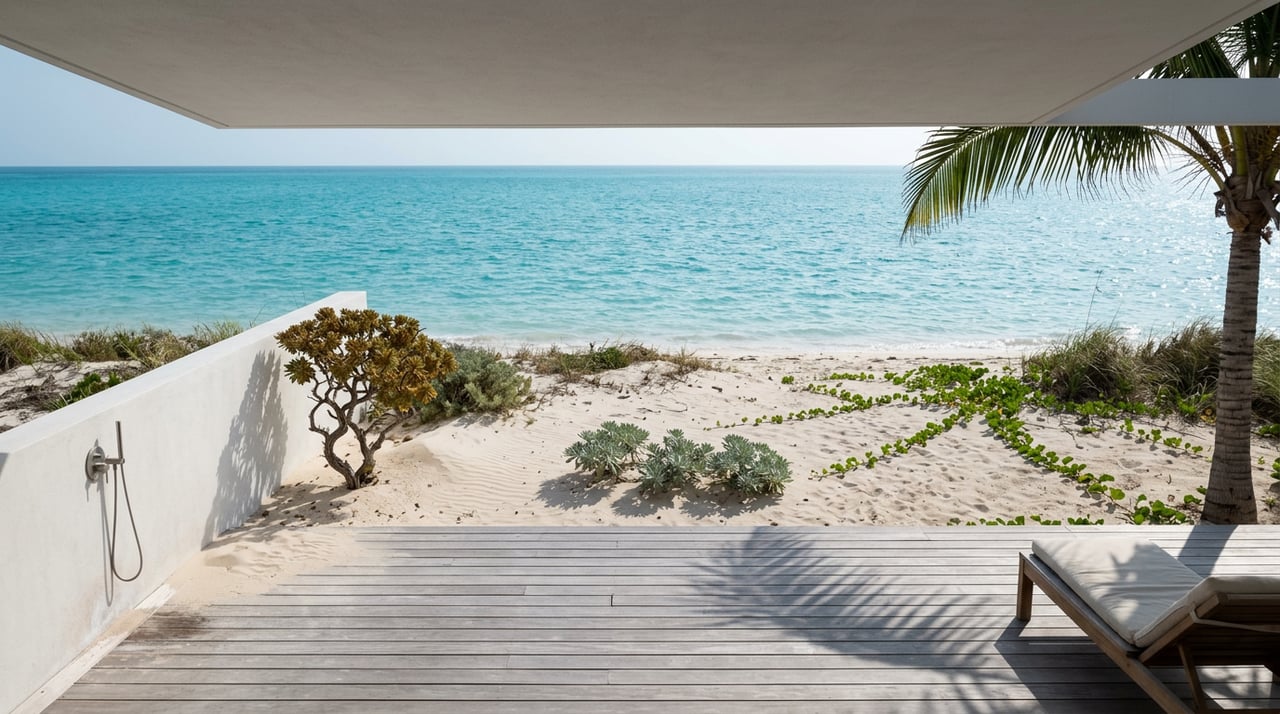
Walk the beach behind Long Bay Hills any morning this week and you will see fewer kites than you would have seen in March. Not none. Fewer. If you have lived here long enough to register that difference without checking a wind app, you already know what this post is about. If you haven't, here is the thing worth understanding: Long Bay does not really have one kite season. It has two, they behave nothing alike, and the switch between them lands right about now, in the third week of August, every single year.
Most of what gets written about this beach treats it as one long, glowing exception to Caribbean wind patterns, a place where the trades blow steady enough that kite schools built a global reputation on it. That part is true. What gets skipped is what actually happens to the beach once the reliable stretch ends, which is not silence. It is a different beach, doing different things, for people who know to look.
Two Products, Not One Long Season
Ask a kiteboarding outfitter here how long the season runs and you will get an answer built for marketing: ten months, November through August, reliable trades nearly year round. That framing is not wrong, but it flattens two very different experiences into one number.
Inside that ten-month window, there is a peak and there is a taper, and the difference matters if you are trying to understand what the beach looks like on any given week rather than what a brochure promises. December through May is the real peak, when the east to southeast trades hold steady enough that a beginner can book a lesson with confidence and an advanced rider can count on a proper power day. June and July soften into a shoulder period, winds still rideable most days but lighter, favored by the foiling crowd who want less push and more finesse. Then comes the stretch nobody puts on a postcard: late August through October, when winds turn unpredictable and hurricane season peaks, and some operators quietly trim their hours.
That is the season we just walked into. Not a shutdown. A different beach.
What the Calendar Actually Means for the Water
Here is the local read on how those four stretches sit against each other:
| Stretch | What's actually happening on the water |
|---|---|
| December to May | Peak trades, 12 to 20+ knots, most consistent window, schools running full schedules |
| June to July | Shoulder season, lighter but rideable winds, popular with foilers, quieter beach |
| Late August to October | Winds go unpredictable, hurricane season peaks, some operators cut hours |
| November | Trades start filling back in, pre-Christmas lessons before high season pricing returns |
The useful detail buried in that table is the overlap most casual visitors never clock: the schools do not close for the quiet stretch. They scale back. If you have a standing lesson booked for late September, expect it to move around more than it would in February, and expect the instructor to be checking three different wind models before committing to a launch time rather than one.
The Reason the Water Stays Flat, Even When the Wind Doesn't
There is a geographic reason Long Bay behaves this way instead of turning choppy and unpleasant the moment the trades ease off, and it has nothing to do with luck.
Long Bay sits right at the northern edge of the Caicos Banks, an enormous shallow shelf that runs for miles out to the south. Trade winds crossing that much shallow water lose the ability to build real swell before they ever reach the beach. What arrives at the launch zone, roughly the stretch between the private homes flanking Beach Enclave and The Shore Club, is flat and clean almost regardless of how hard or soft the wind is blowing that day. It is the same mechanism that makes this beach forgiving for a first-time kiter in February and forgiving for an intermediate foiler picking through light air in September. The Banks do not care what season it is. They just keep the water from turning into something the sport can't use.
That is the part worth holding onto if you live here and have ever wondered why Long Bay never seems to get genuinely rough the way exposed Atlantic-facing coastlines do elsewhere in the Caribbean. The shelf underneath the water is doing more work than the wind gets credit for.
What Fills the Gap While the Trades Take a Break
The quiet stretch is not a dead stretch, and this is where the beach actually gets more interesting to watch, not less.
Wing foiling has become the default answer to a lighter wind day. A handheld inflatable wing replaces the kite and control bar entirely, the learning curve is shorter, and the sport needs meaningfully less wind to work than traditional kiteboarding does. Kite Provo, Big Blue Collective, and Turks and Caicos Kiteboarding, the three schools that share this stretch of sand, have all added wing foiling to their lesson lists in the last few years, and it is one of the few local water sports that works just as well in Grace Bay's calmer conditions as it does at Long Bay, which means riders who might otherwise sit out a flat week now have somewhere to go instead.
On the days where even that doesn't have enough push, e-foiling takes over. Electric motor foil boards need no wind at all, and they have become the go-to for flat, no-wind mornings on this stretch of coast, the exact kind of morning late August tends to produce more of than April does.
And then there are the mornings with no kites in the air whatsoever, when the only thing moving through the shallows is a small herd from Provo Ponies. The stable is the oldest on the island, started more than twenty years ago by Camille Slattery as a rescue operation for horses brought over from the Dominican Republic, and the herd now runs past twenty animals sourced from as far as Grand Turk and South Caicos. Group rides move down quiet residential roads through Long Bay Hills, straight onto the beach, and directly into the water, which means on a slow wind morning, the most reliable motion on Long Bay Beach might not be a kite at all.
The Tournament This Beach Used to Have
There used to be a bigger reason to circle a date on the calendar here. From 2007 through 2016, Providenciales hosted the Windvibes Kiteboarding Tournament, an annual competition that started as a straightforward kiting event and grew to include kayak and stand-up paddle racing, windsurfing, even log-throwing and tug-of-war. Hope LeVin and the local kiteboarding community ran it for a full decade before it quietly stopped after 2016 and was never revived. Nearby destinations like the Dominican Republic still run their own tournaments. Long Bay doesn't, and hasn't for a decade.
It's a small fact, but it says something true about how this beach actually functions day to day. It was never really built around a marquee event. It runs on consistency instead, the same shallow water and the same steady wind pulling the same rotation of schools, riders, and now horses back onto the sand, season after season, whether or not anyone is keeping score.
That is the real shape of Long Bay's calendar. Not one long, uninterrupted season, but a rhythm with a peak, a shoulder, a lull, and a return, repeating every year with enough regularity that the people who live alongside it stop needing an app to tell them which part they're standing in.
If you're weighing what a stretch of coastline like this actually means for day to day life here, or thinking through what ownership near a beach with this kind of rhythm looks like in practice, Sean O'Neill has spent years reading Providenciales at exactly this level of detail. Schedule a consultation when you're ready to talk it through.