Every pricing conversation about land in Turks and Caicos starts with the same number: on Providenciales, a waterfront acre carries a median price near $3,048,000, while land off the water runs closer to $584,000, according to the most recent published market analysis, updated in January 2026. Buyers arrive in Turtle Tail with that ratio already in their heads, assuming the lot closest to the ocean is the one worth paying for.
That assumption breaks down here in a way it doesn't in Grace Bay or Long Bay. Turtle Tail's shoreline is mostly low limestone ironshore, broken up by small beaches so shallow that several disappear entirely at high tide. The premium lot on this peninsula isn't the one that touches water. It's the one sitting highest above the road that floods when a storm surge comes through.
A Peninsula That Was Never Built Around a Beach
Turtle Tail separates the interior Flamingo Lake and Juba Point Salina from the open Caicos Banks, a narrow limestone finger with two named high points, Bristol Hill and Jim Hill, that top out around 75 feet. That's the entire vertical range available on the peninsula. There's little topsoil, so vegetation stays low and close to the ground, especially on the windward slopes facing the trade winds.
This matters because the pricing logic that governs Grace Bay condos or Long Bay villas, where beach frontage is the entire product, doesn't transfer cleanly. A handful of tiny beaches interrupt the ironshore in places, some just 50 feet long, but they're mostly accessible only from the villas built directly above them. The water is genuinely turquoise and the views are real. What's for sale, though, is elevation on a narrow ridge, not a stretch of sand.
The only paved way in is Venetian Road, a winding route that's counted among the more scenic drives on the island. That single point of access is part of why the peninsula still reads as private even as building activity picks up around it. Most of Turtle Tail remains undeveloped land today, which means the buyers shaping current pricing are the ones choosing between building on the ridge or building near the flats, not the ones choosing between finished inventory.
What the Storm-Surge Line Actually Changes
Here's the detail that doesn't show up in the glossy villa write-ups: Turtle Tail is one of the specific neighborhoods flagged for road flooding from storm surge during significant tropical cyclones. Roads can become impassable, and even wading a vehicle through saltwater at a shallower depth accelerates corrosion and shortens the car's life.
That single fact reframes the elevation math. A lot near Flamingo Lake or close to the salina flats might come with a lower asking price and an easier build site, but it also sits closer to the water table and closer to the road segments most likely to flood during a major storm. A lot up on the Bristol Hill or Jim Hill side of the ridge costs more to buy and, in some cases, more to build on because you're excavating into rock rather than fill. What you're buying with that premium is the ability to still reach your own driveway after the storm passes, and a foundation that was never sitting in the flood path to begin with.
The lots that look like a bargain on Turtle Tail are usually the ones giving up the one thing the peninsula was built to offer: staying above the water when the water decides to move.
The Cost Stack Before You Pour a Slab
Buyers who've built elsewhere in the U.S. or the U.K. tend to underestimate how much of the Turtle Tail budget gets spent before construction starts. A few specifics worth knowing going in:
A topographical survey using LiDAR runs around $2,500 as of 2025 pricing, and most architects will want one before they finalize a design on ironshore terrain where grade changes matter. Foreign architects can design the home, but the plans need sign-off from a locally licensed architect before submission, with limited exceptions for single-story residential builds. Planning permission typically takes around three months, and construction can't begin until both planning permission and a separate building permit are in hand.
Two building code specifics apply island-wide but land differently on a peninsula like this one. A cistern is mandatory in new construction, which matters more in Turtle Tail than in neighborhoods fully served by piped City Water, since not every parcel on the peninsula has that connection. Wood-frame construction is generally prohibited outside of small structures like gazebos and palapas, which pushes nearly every build toward reinforced concrete block or poured concrete, both of which hold up far better against the ironshore's exposure to salt air and storm wind than lighter framing would.
None of this is unique to Turtle Tail. What's specific to this peninsula is how much the site itself, not just the code, drives the engineering. Which brings up the project that found this out the hard way.
The Site That Surprised Its Own Architects
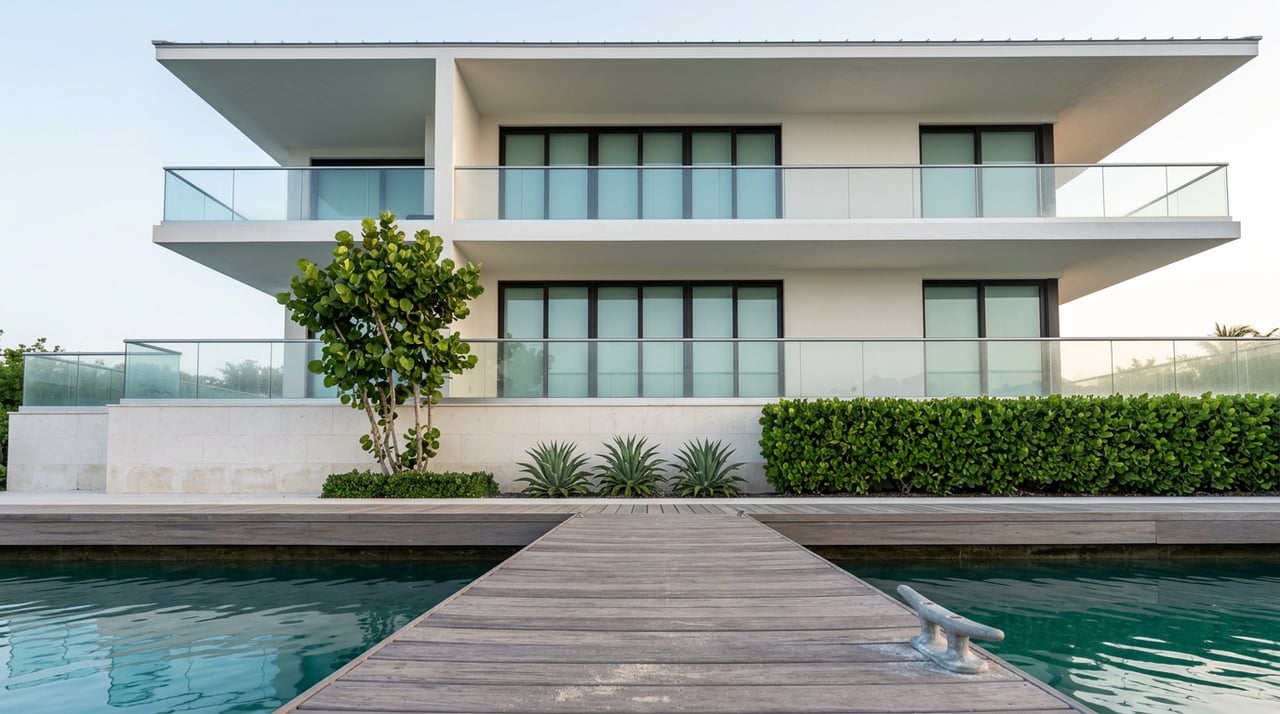
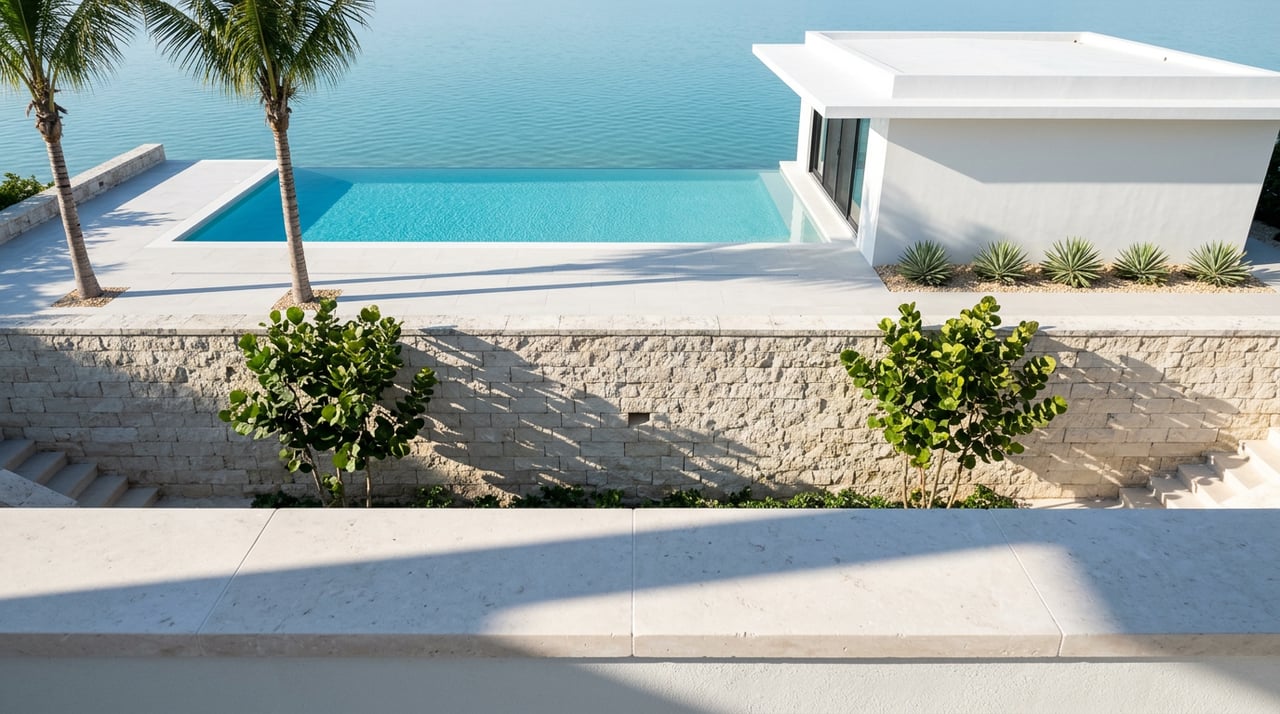
When the design team at Blee Halligan began early site work on what became Perched Rock Villa, a two-home estate on the Turtle Tail peninsula, they found the land had already been stripped of its native vegetation and regraded to fill in a low-lying section of salina facing Juba Sound. The rugged ironshore and its established vegetation had survived intact, so the team protected that portion, while treating the regraded, formerly wet ground as a different design problem entirely, building a new tropical garden in the shelter of the prevailing wind and a separate arid landscape on the perched, beach-adjacent side.
That's a professional architecture firm discovering, after the land was already under contract, that two parts of the same parcel behaved like two different sites. It's the clearest illustration available of why a topographical survey and a real site walk matter more on this peninsula than a listing photo or a satellite view ever will. Ironshore and regraded salina fill can sit fifty feet apart on the same lot and require completely different foundation approaches.
What's Actually Selling on the Peninsula Right Now
The transactions moving through Turtle Tail right now tell the elevation story plainly. A 0.94-acre site on Ocean Drive, offering up to 30 feet of elevation and the potential for water views once built, sold in September 2025. Thirty feet doesn't sound like much against a mainland ridge, but on a peninsula where the highest points reach 75 feet, it's a meaningful fraction of everything the terrain has to offer, and it's exactly the kind of parcel that draws attention precisely because it clears the flood line by a comfortable margin.
At the other end of the spectrum sits a newer option for buyers who'd rather skip the ironshore engineering entirely: The Docks at Turtle Tail, a canal-front enclave of twelve villas, seven of them with private boat slips, with rental management arranged through The Turquoise Group. That's the build-versus-buy fork in Turtle Tail right now. Raw ironshore land on the ridge rewards patience, a good architect, and a real site survey. A finished canal-front villa in a managed enclave trades that process for a higher purchase price and someone else's engineering decisions already made.
There's also a working alternative to canal living already in place on the peninsula's western edge. South Side Marina, tucked into Cooper Jack Bay, has operated as a small harbor and port of entry since 1992, when its founder purchased the first boat lot along what was then, by his own account, a very bumpy road called Turtle Tail. It anchors the canal network running through Cooper Jack Bay and Discovery Bay, and its onsite bar has become the kind of local fixture that shows up in cruiser reviews more than real estate listings, complete with Wednesday live music. It's a useful reminder that Turtle Tail already has working boating infrastructure in one corner of the peninsula, even while most of the interior lots remain raw.
For buyers who want the resort-adjacent version of Turtle Tail without building from bare land, the Agency's own Wymara Villas development sits on the peninsula as well, with an onsite restaurant serving as one of the only dining options in an area that otherwise has none.
The Read
None of this means the ridge lots are automatically the right buy or the flats are automatically wrong. Some buyers want the lower elevation, accept the flood exposure as a known tradeoff, and value the shorter walk to a private cove more than the extra height. What matters is buying with that tradeoff named, rather than assuming Turtle Tail pricing follows the same waterfront-versus-inland formula that governs the rest of Providenciales.
If you're evaluating raw land on this peninsula, the questions worth asking before you make an offer are specific: what's the parcel's actual elevation profile, not just its distance from water. Has the site ever been regraded or filled, and is any part of it built on former salina rather than native ironshore. What would a LiDAR survey and a licensed local architect tell you about foundation costs before you're locked into a purchase agreement.
Sean O'Neill works Turtle Tail land deals with that level of specificity built in from the first site visit, backed by The Agency's local presence and its access to the architects, engineers, and planning contacts who already know this peninsula's terrain. If you're weighing a ridge lot against a canal-front enclave, or trying to figure out what a parcel's elevation is actually worth before you commission a survey, schedule a consultation with Sean O'Neill before you write an offer, not after.
Frequently Asked Questions
Is a cistern really required for every new home in Turtle Tail? Yes. A cistern is mandatory under Turks and Caicos building code for new construction islandwide, and it carries added weight in Turtle Tail specifically because not every parcel on the peninsula has a piped City Water connection.
Can I use a foreign architect for a Turtle Tail build? You can design with a foreign architect, but the plans need sign-off from a locally licensed architect before submission, with some exceptions available for single-story residential homes.
How long should I budget for planning permission? Roughly three months is typical, and that clock doesn't start until after the design process itself, which usually takes several months of back and forth between architect and client before plans are ready to submit.