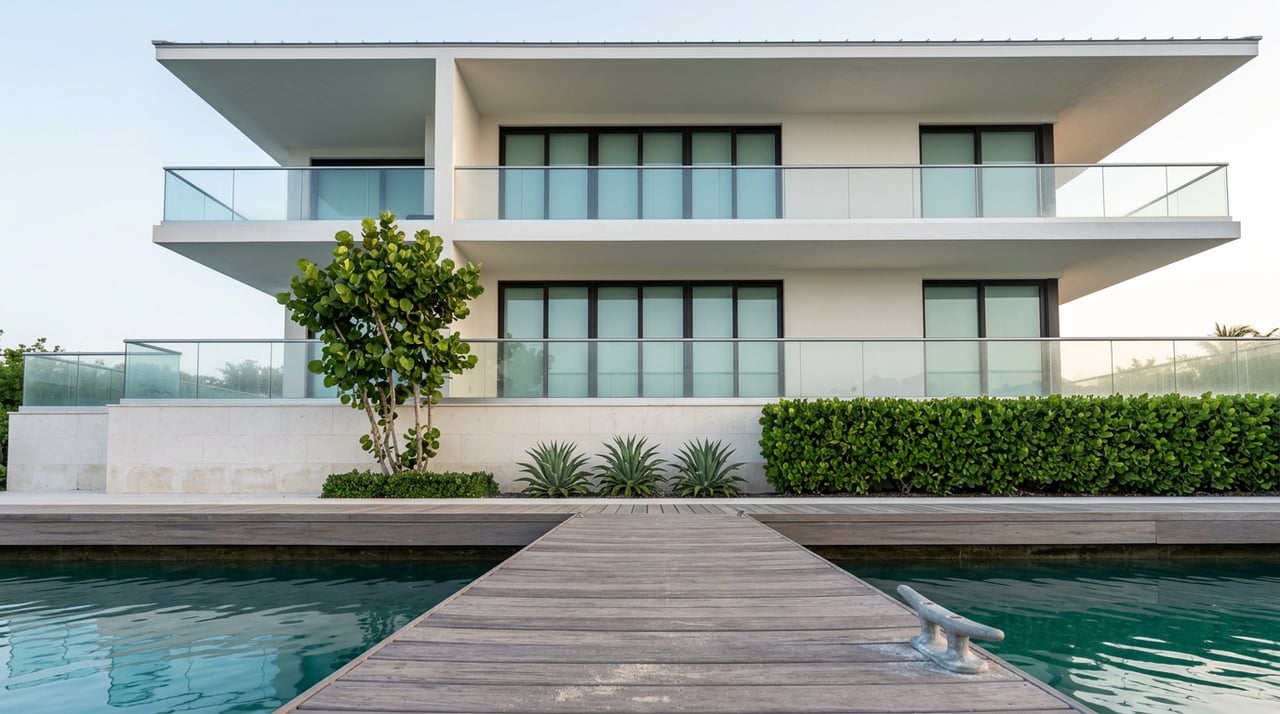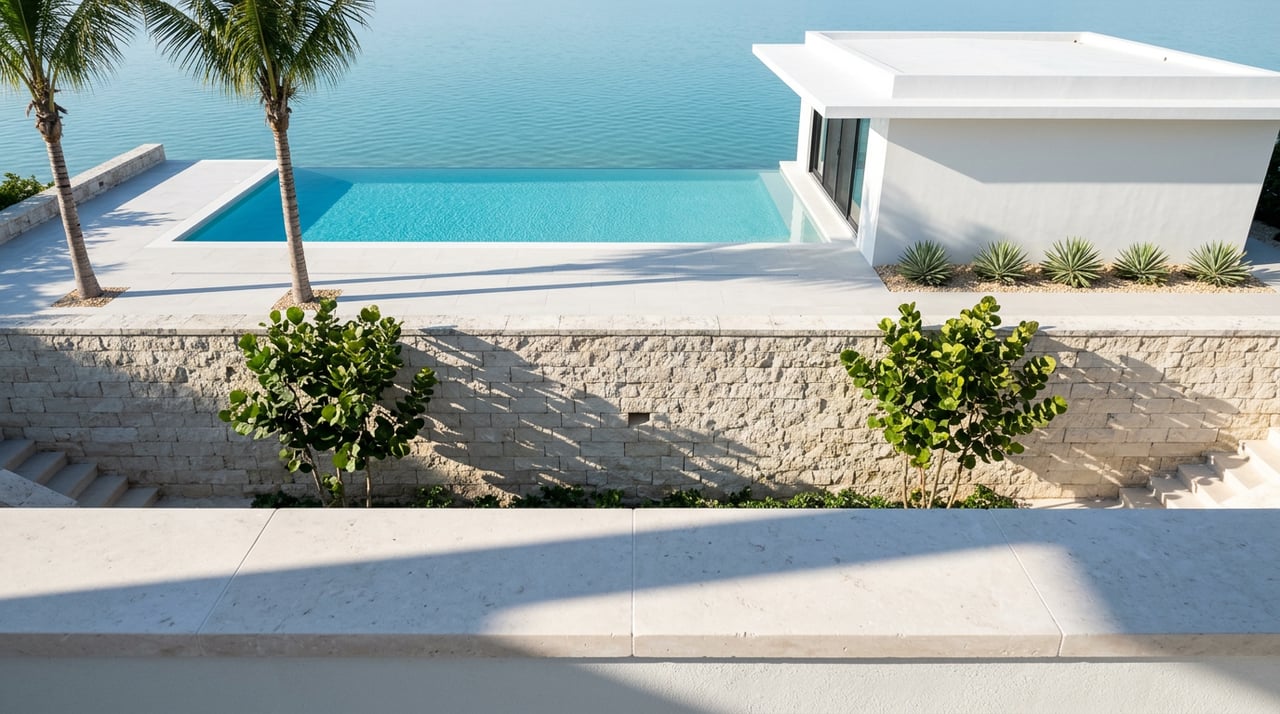
In January, the deck at Land's End fills before breakfast. Guests angle binoculars east toward the Turks Island Passage, tracking the spout of a humpback whale on its way south from the North Atlantic. The resort renovated this four-bedroom villa specifically to work this view, giving the spot a name of its own: Whale Watcher's Point. Five months later, the same island looks like it belongs to a different property altogether. A cluster of low bungalows that didn't exist in January now lines a calm waterside channel near the Club House, kayaks racked at the door instead of a tide chart on the wall.
Both scenes are Ambergris Cay. Neither one is the whole story. The island now runs two distinct seasonal identities, each with its own real estate built to match, and understanding which calendar you're standing in explains a lot about why the place feels different depending on when you're there.
A Private Island Before It Was Ever a Resort
Ambergris Cay has been privately owned since 1811, and it saw little development for most of the time since. It stayed that way through most of the 20th century, home to little more than a few failed sisal plantations and stations tied to the old whaling and ambergris trade. The island's separateness ran deep enough that in 1978, a group of Arizona investors reportedly offered $50 million to secede from Turks and Caicos entirely and issue their own currency. The offer went nowhere, but the impulse behind it says something about how this place has always been regarded.
The island didn't open as a resort until 2019. That's 208 years between purchase and its first paying guest. Everything about how Ambergris Cay operates today, the low bungalow count, the single pool, the golf-cart-only roads, reads like a homeowners' community that reluctantly agreed to let guests in rather than a resort that happened to have some houses on it. That order of operations matters. It's why the resort's expansions still get built around private ownership rather than the other way around.
Winter Is Built Around One Villa
High season on Ambergris Cay runs December through April, and inside that window, whale watching narrows the calendar further to January through March, when humpbacks pass through the Turks Island Passage on their migration south. The resort's response wasn't to add a whale-watching excursion to a brochure. It renovated an actual villa around it. Land's End, a 4,660-square-foot, four-bedroom oceanview property, was fully rebuilt this year with its whale-season sightlines as the point, according to Caribbean National Weekly's coverage of the resort's 2026 accommodations expansion.
"Ambergris Cay continues to attract discerning travelers who value seclusion, direct private air access, and an experience that feels entirely their own," said Andreas Naegele, Vice President of Hospitality at Waterloo Hotel Management Ltd., the company that now operates the resort.
That's the winter product in a sentence. Quiet, singular, tied to a natural event that only lasts about ten weeks a year.
Then the Island Rebuilds Itself for Summer
Come June, the whole equation flips. A spring 2026 review of the resort put its bungalow count at 17, alongside 11 villas, a small footprint by any resort's standard. By the time the new Waterside Bungalows opened for summer stays starting in June 2026, that number nearly doubled, to 29. Twelve new units against a base of 17 isn't an incremental add. It's the resort effectively building a second product line in a single season.
The two new villas that arrived alongside them, a 5,446-square-foot beachfront property called Olympus and a 5,780-square-foot villa called Tidecrest, lean toward relaxed, group-oriented island living rather than the romance-and-whales pitch built around Land's End. The resort's largest offering, Dream Estate, grew too. It debuted in early 2025 at just under 19,000 square feet with 10 bedrooms, and the 2026 expansion pushed it to 19,337 square feet and 11 bedrooms, positioning it among the largest private residential resort offerings in the country. A new Kids Club, arriving near the Waterside cluster in time for the 2026 holiday season, makes the target guest for this expansion obvious: it isn't the couple staking out Whale Watcher's Point.
The resort's own comparison of its two bungalow types makes the split explicit:
| Beachfront Bungalows | Waterside Bungalows | |
|---|---|---|
| Setting | Sandy beachfront along the shore | Calm waterside, near the Club House |
| View | Ocean views over the beach | Tranquil water views |
| Water access | Steps to the beach and open water | Direct calm-water access from the terrace |
| Water sports | Swimming in open water | Kayak and paddleboard from your door |
| Best suited for | Beach lovers, romance seekers | Kayakers, paddleboarders, families, social guests |
Same island, same all-inclusive plunge-pool format, two different guests being served by design.
What Never Changes Between the Two Calendars
However the season swings, a few things on Ambergris Cay stay fixed, and they're worth knowing if you're the one living around them rather than visiting for a week.
- Golf carts are the only way to move around. There are no rental cars, and the island's small road network was never built for anything larger.
- There's no fuel sold on Ambergris Cay itself. Anything requiring fuel gets handled through Atlantic Aviation's private terminal back in Providenciales.
- The island runs its own water and power, using reverse osmosis purification and independent electrical generation rather than pulling from a mainland grid.
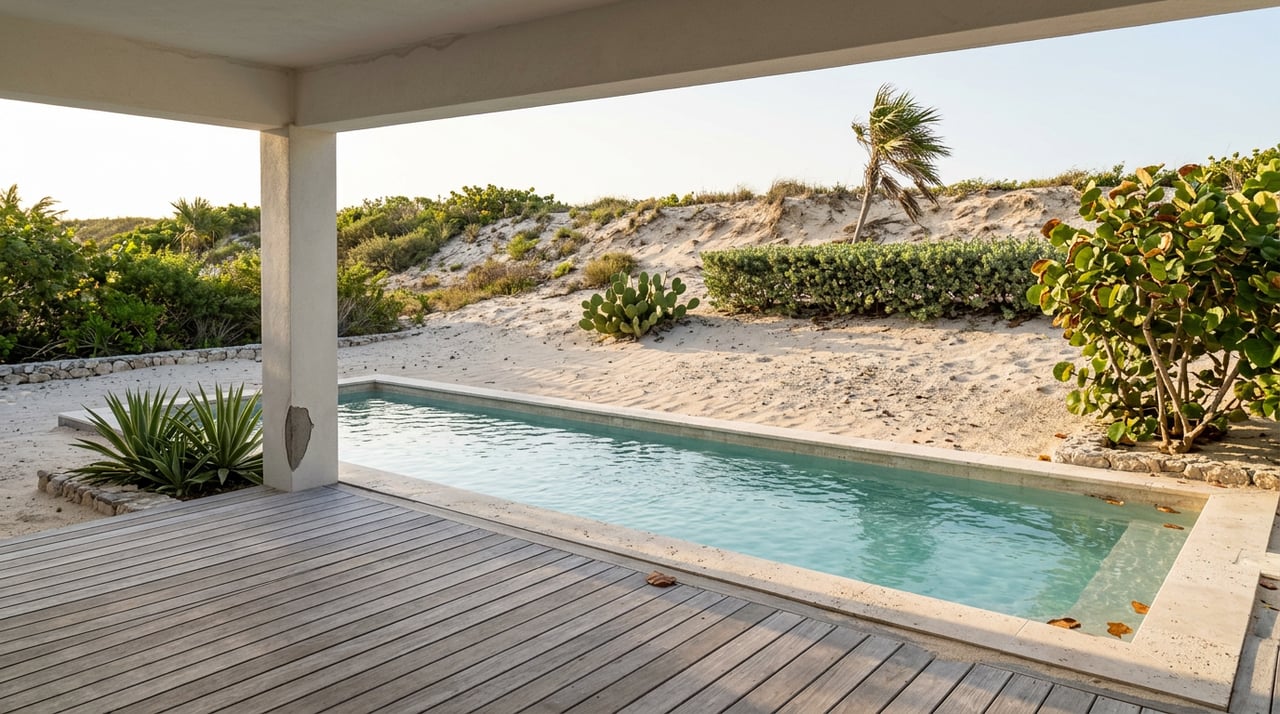
- There's a single swimming pool, set on Monck Beach near the Club House, deliberately modest for a property with dozens of accommodations.
- The signature day trip doesn't happen on Ambergris Cay at all. It's a boat ride to Little Ambergris Cay, an uninhabited nature reserve a mile west, home to the floating Hangover Tiki Bar.
Despite its modest footprint, the island supports more than 150 plant species, from wind-shaped bonsai forests to old mangrove stands, a detail that has nothing to do with either season's marketing and everything to do with why golf-cart exploring stays worth doing whether or not the whales are around.
A Faster Way In, Same Discipline at the Door
Getting to Ambergris Cay changed meaningfully last year. American Airlines launched nonstop service between Miami and South Caicos in March 2025, flying the 627-mile route twice weekly on Wednesdays and Saturdays, according to Visit Turks and Caicos Islands. Before that route existed, reaching South Caicos meant connecting through Providenciales by domestic carrier or ferry. More than a year later, the resort's own site still flags the route as new, which says something about how significant a shortcut it represents for guests coming from the U.S. East Coast.
What hasn't changed is what happens after you land. Ambergris Cay still requires its own complimentary private flight for the final leg, about ten minutes from South Caicos or twenty from Providenciales's Atlantic Aviation terminal, and the island's runway, at 5,700 feet, remains the longest private airstrip in the Caribbean. The mainland got closer. The island didn't loosen the gate because of it.
Two Seasons, One Set of Rules
None of this changes whether Ambergris Cay is worth visiting in any given month. It changes what you should expect to find when you get there. A January stay built around Whale Watcher's Point and a June stay built around the new Waterside cluster aren't variations on the same trip. They're two different products, aimed at two different guests, running on the same 1,100 acres under the same low-density rules that have governed this island since long before anyone could book a room on it.
If you already spend time on Ambergris Cay, or you're weighing what a stake there actually looks like across both halves of the calendar, Sean O'Neill has spent years tracking how this island's private ownership side moves alongside its resort side. Schedule a consultation to talk through what's changing and what it means for property here.